World Cup 2026: Why are the underdogs doing so well?
This 48-team World Cup has produced some intriguing match-ups and several impressive performances by lower-ranked sides against the world's top teams.
Cape Verde, Curacao, Ghana and South Africa - ranked 64th, 81st, 65th and 54th respectively - have taken points from Spain (3rd), Ecuador (29th), England (4th) and South Korea (28th) so far.
Are these early tournament surprises a matter of luck, or clever planning and execution?
A deeper delve into what happened in the games that produced those unexpected results reveals a number of common patterns.
Don't take the bait
Cape Verde's 0-0 draw against Spain was perhaps the biggest upset of the tournament so far and it was also perhaps the most tactically impressive.
The third-smallest nation in World Cup history stifled Spain through their 4-5-1 defensive shape. Key to their success was the fact gaps between their midfield line and defensive line were very small.
Against such a challenge, high-possession sides look to pass the ball backwards, hoping to entice the opposition to step up the pitch.
When Spain passed it back, expecting the midfielders to engage and create space between them and the defenders, Cape Verde didn't take the bait, instead keeping their shape compact.
The Spain defenders then carried the ball forward looking to trigger a reaction but the Cape Verde players, again, held their shape until late.
Spain, as a result, found it difficult to find players inside the block. Their remaining solutions were therefore either around Cape Verde or over the top of them.
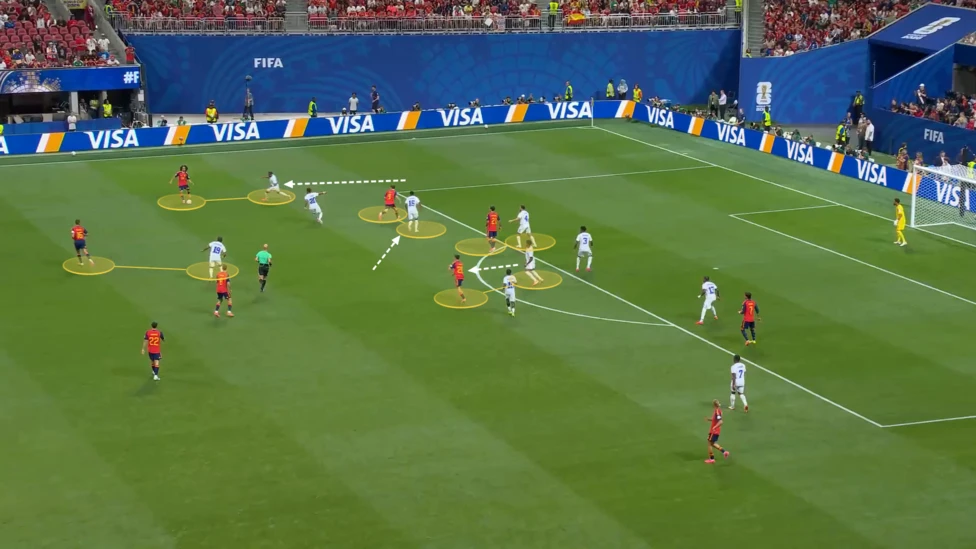
Screengrab from Spain 0-0 Cape Verde showing their vertically compact 4-5-1 shape. Drawn are arrows showing the movement of players.
This exact pattern was seen in Ghana's defensive set-up against England too.
England under Tuchel have placed an even greater emphasis on dropping deep to entice pressure before quickly attacking the space that opens up.
Ghana prepared for this by setting up in a compact formation. Jordan Ayew took a position higher up the pitch to man mark Elliot Anderson but the rest of the side, like Cape Verde, set up in two lines just outside of their penalty areas, giving up no space between the lines.
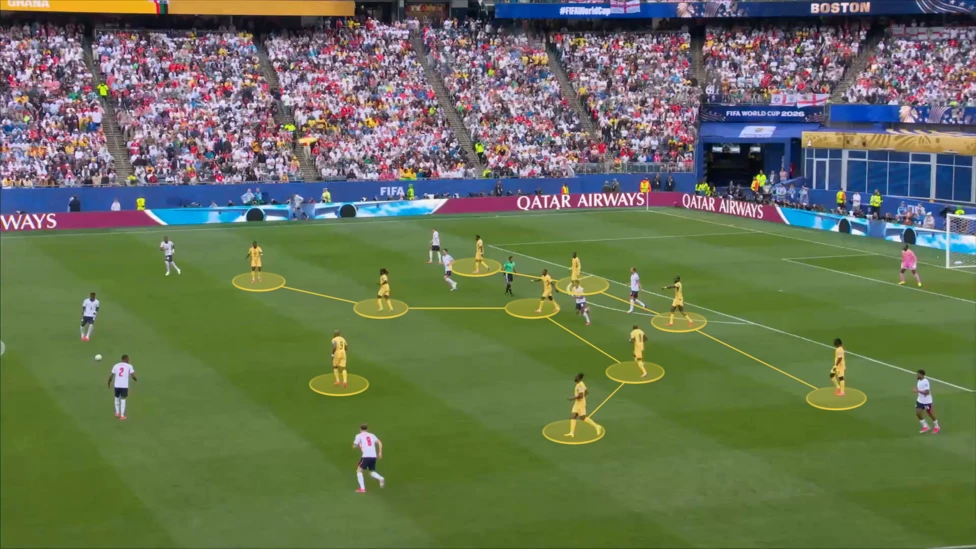
Screengrab from England 0-0 Ghana showing their vertically compact 4-5-1 shape. Drawn are circles with joining lines connecting the five midfielders, and separately the same is shown for the four defenders.
Both sides' refusal to apply pressure when the opposition attempted to tease them out is best illustrated by a statistic that looks to quantify how intensely a team presses.
'PPDA' stands for 'opposition passes allowed per defensive action'. The higher the number, the less a team has been able to interrupt opposition spells of play.
In Cape Verde's draw to Spain, their average PPDA was 51.2 to Spain's 5.9.
In the first 15 minutes of Ghana's match against England, their PPDA was 62.
Both underdog sides were passive and deliberately so.
Interestingly, both Ghana and Cape Verde did increase the amount they pressed as the game went on. This could partly be explained by teams, such as Ghana, looking to take greater initiative and risk, hoping to snatch the game at the end.
Cover the width of the pitch
To understand why some underdogs have done well, it makes sense to analyse where others have, in contrast, been exploited.
Saudi Arabia's loss to Spain best highlighted a key flaw seen across many sides who 'park the bus'.
On the face of things, five defenders suggest a team should be better equipped to defend - but the opposite was true.
Saudi Arabia in their back five lacked clarity and were drawn to the player on the ball too often.
In their low block, their midfield four shifted towards the ball-side of the pitch more than they should have. This meant they failed to cover the width of the pitch. Recognising this, Spain switched the ball well, often from left to right.
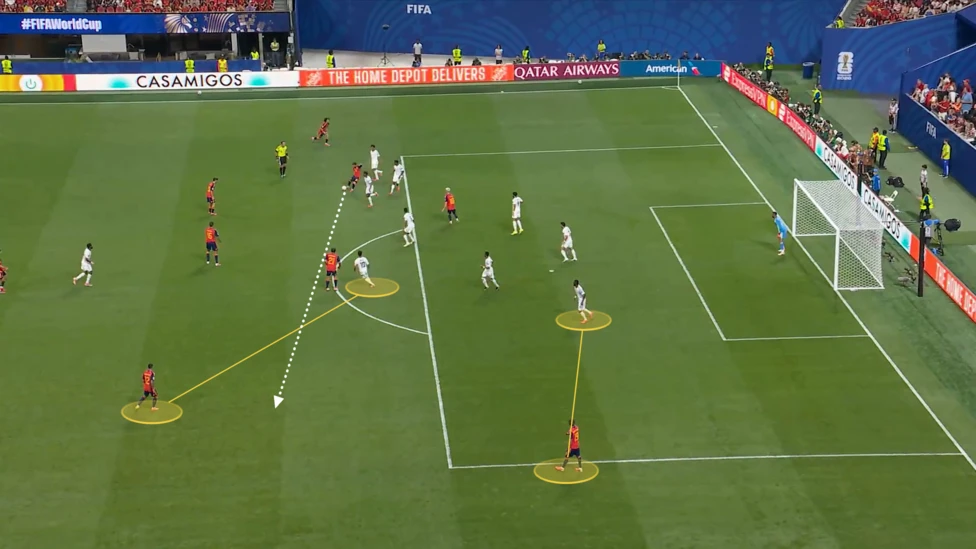
Screengrab from Spain 4-0 Saudi Arabia showing how narrow Saudi Arabia's left midfielder and left wing-back are positioned. A yellow line connecting them to the Spain attackers they should be defending is drawn to illustrate the distance between them.
Lamine Yamal and Pedro Porro found themselves in two-against-one situations against the Saudi Arabia wing-back and this overload led to Spain's third goal.
The wide midfielder, drawn to the ball, struggled to get back across to apply pressure on to Porro when the ball was switched. The wing-back failed to step out to Porro too, knowing that if he did, Yamal would have been free.
With time and space on the ball, Porro played a cross to the back post which was knocked into a more central position for Mikel Oyarzabal to tap in.
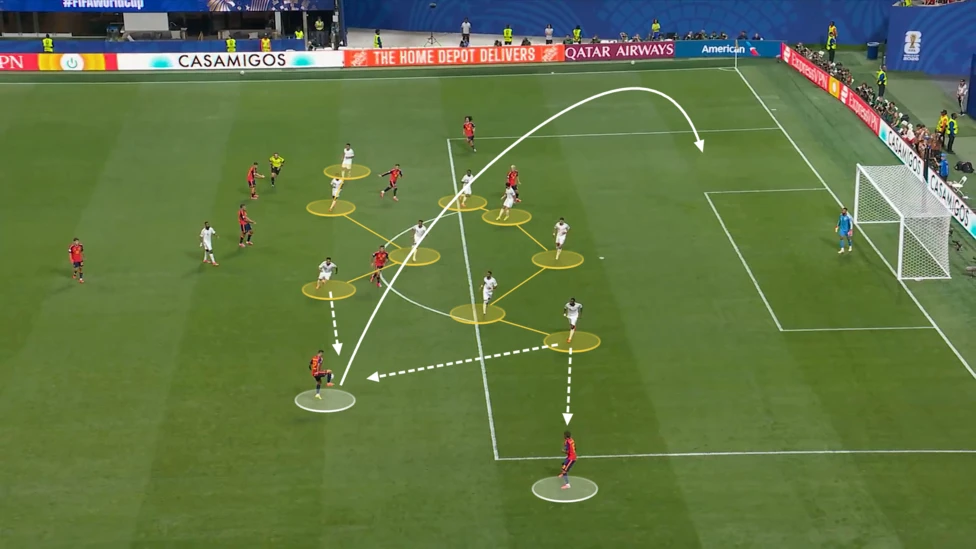
Screengrab from Spain 4-0 Saudi Arabia showing Saudi Arabia's left midfielder and left wing-back unable to close down Pedro Porro due to the distances between them. This distance is shown via arrows to Porro. The trajectory of Porro's back post cross is drawn with a curved arrow.
Sweden, ranked 36th and underdogs in their game against the eighth-ranked Netherlands, lost 5-1 because of the same defensive frailty. Having just three midfielders in their 5-3-2 shape gave them even less coverage of width in midfield, compared to Saudi Arabia's four-man midfield.
The Netherlands used their right-winger to pin Sweden's left wing-back deep.
As Sweden's midfield three moved towards the ball, Denzel Dumfries, from a deeper starting position, made good forward runs that were not picked up.
Sweden failed to cope with this two-against-one situation and improved only when they moved to a 4-5-1 shape - as Cape Verde and Ghana did - later in the game.
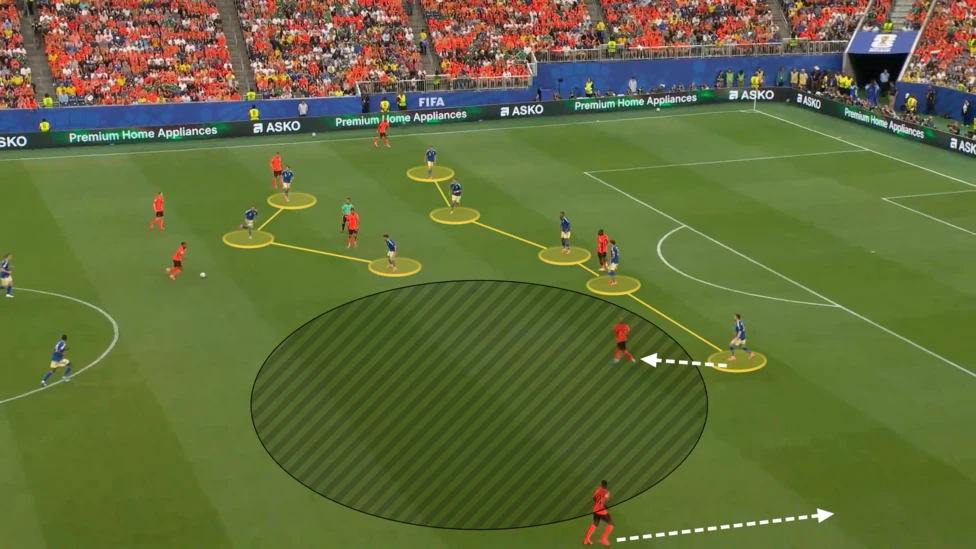
Screengrab from Netherlands 5-1 Sweden. Drawn are yellow circles and lines connecting the Sweden players to illustrate the 5-3-2 shape. A circle is drawn on the far-side of the pitch to illustrate the space in midfield. Arrows are drawn to show off-the-ball movement of Dumfries (forward) and Malen (backwards)
Attract the press then go long
And lastly, if teams are going to get results against strong opposition, they ideally need to pose their own threat on the ball.
South Africa took 14 shots to South Korea's seven in their match while only having 31% of the ball.
Their ability to get the ball up the pitch, in a more deliberate manner, rather than simply playing long from the goalkeeper was central to this.
Underdogs that have done well have often played short from goal-kicks, drawing pressure from the bigger nations who are more inclined to press high, before chipping it into clusters of players in space.
We have seen the likes of Cape Verde, Iraq, and South Africa all use short goal-kicks, interestingly positioning players far from one another.
The idea is that by creating large distances between players, opponents who want to press man-for-man have to run big distances to close the opponent down. In the time that this takes, defenders can look to find midfielders and attackers in space.
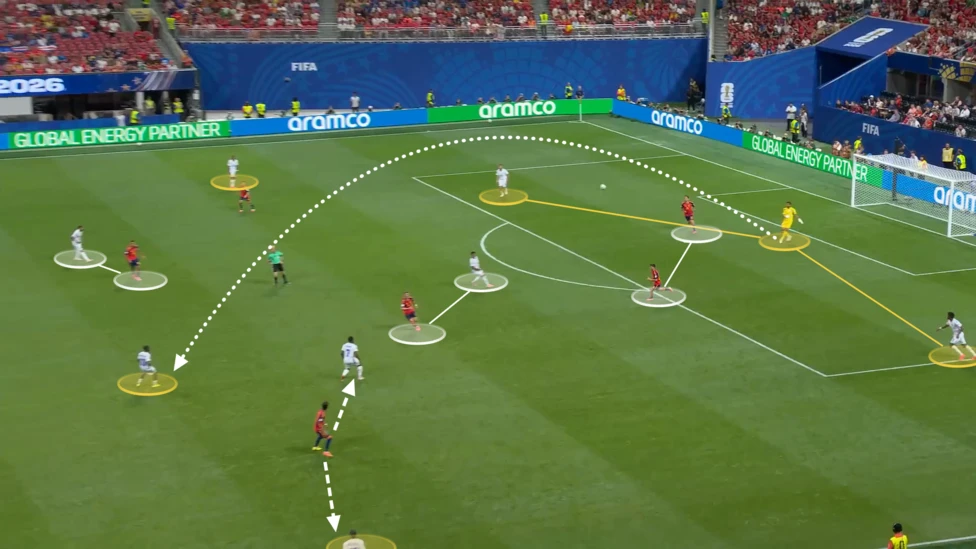
Screengrab from Spain 0-0 Cape Verde showing their wide and deep positioning from goal-kicks. Cape Verde overload the midfield and some of Spain's midfielders have multiple players to decide between picking up – these options are drawn as arrows between the Spain player and the many Cape Verde players.
Playing out from the back while keeping big distances between players increases the risk of losing the ball in dangerous areas. South Africa, against Mexico, and Iraq, against Norway, conceded goals from these situations.
They did however create numerous good chances too and better final actions could have swung the story of the game.
Football is a sport of trade-offs and when South Korea pressed South Africa high, the Bafana Bafana stuck to their principles, playing it forward in a more precise manner.
Once up the pitch, they attacked quickly and scored the goal that ensured they progressed into the next stage of the competition.
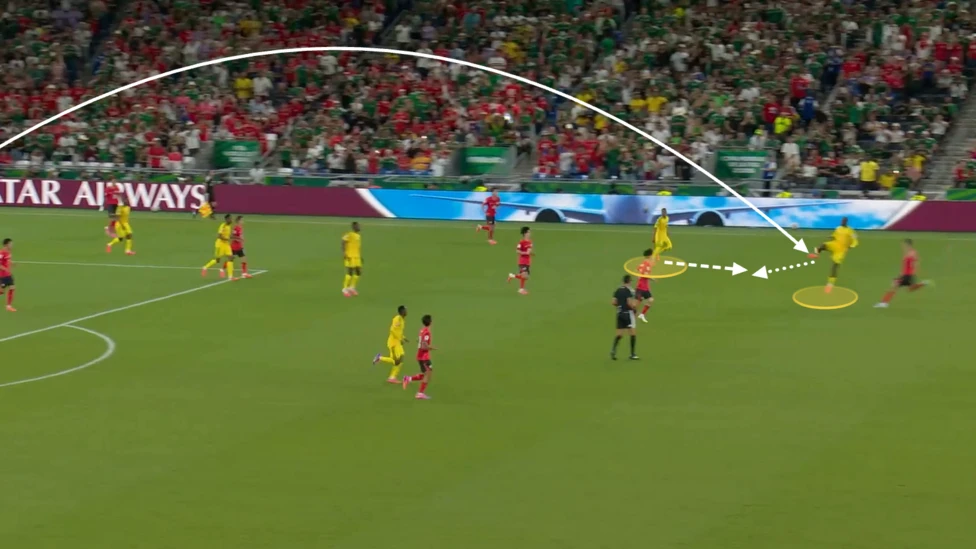
Screengrab from South Africa 1-0 South Korea. Via drawn arrows, the trajectory of the ball is illustrated as a South African defender dinks the ball into midfield and the forward flicks it on for teammate.
And a bit of quality
These examples highlight the increasing level of tactical quality nations possess, irrespective of their ranking.
Even with players of a lesser quality, teams can pose real challenges when setting up in the right way, pulling in a collective direction.
And even then, they probably need things to go their way.
In this tournament, 40 year-old keeper Vozinha captured the hearts of many for his brilliant shot-stopping display against Spain.
Curacao's keeper Eloy Room matched the World Cup record for most saves made in a game, at 15, to help his nation get their first point too.
Tactics can help the smaller nations bridge the gap and play on their own terms but the aura of the World Cup appears to bring out of players a level of performance that they perhaps did not know they possessed.
中文翻譯(zh-TW)
這屆 48 隊規模的世界盃,產出了不少耐人尋味的對戰組合,也看到好幾場排名較低的球隊對世界頂級強權交出令人印象深刻的表現。
維德角、庫拉索(Curacao)、迦納、南非——FIFA 排名分別是第 64、81、65、54——目前已分別從西班牙(第 3)、厄瓜多(第 29)、英格蘭(第 4)和南韓(第 28)身上拿走分數。
賽事早期的這些意外,是運氣使然,還是縝密規劃與執行的結果?
把那些爆冷比賽再仔細拆解一遍,會看到幾個共同的模式。
不上鉤
維德角 0:0 逼平西班牙大概是目前為止這屆世界盃最大的冷門,也或許是戰術上最令人驚艷的一場。
世界盃史上第三小的國家,用 4-5-1 的防守陣型把西班牙悶住。關鍵在於:他們中場線與後防線之間的縫隙非常小。
面對這種陣型,控球率高的球隊通常會把球往後傳,希望引誘對手向前壓上。
但當西班牙把球回傳、期待維德角的中場線吃餌往前撲、好讓中場與後衛之間出現空檔時,維德角根本不上鉤,仍維持陣型緊湊。
接著西班牙後衛帶球向前,想再次製造反應;維德角球員照樣穩穩持住陣型,直到最後一刻才出腳。
結果就是西班牙很難把球塞進對方防守區塊(block)裡。剩下的辦法只剩繞過去外圍或挑過頭頂。
西班牙 0:0 維德角擷圖,顯示維德角縱向緊湊的 4-5-1 陣型,箭頭標示球員移動。
迦納對英格蘭的防守佈陣,也看到同樣的模式。
Tuchel 麾下的英格蘭格外強調回收陣型、引誘對手施壓,再趁打開的空間快速反擊。
迦納為此擺出緊湊陣型應對。Jordan Ayew 站得稍高去人盯人盯住 Elliot Anderson,其他球員則跟維德角一樣,在自家禁區外圍排成兩條線,線間不留空檔。
英格蘭 0:0 迦納擷圖,顯示其縱向緊湊的 4-5-1 陣型。圖中以圓圈與連線標示五名中場與四名後衛的位置。
兩隊都拒絕在對手挑釁時主動壓上,這一點透過一個量化壓迫強度的數據可以看得最清楚。
「PPDA」代表「對方每次防守動作之間允許的傳球數」(opposition passes allowed per defensive action)。數字越高,代表這隊越少打斷對手的進攻節奏。
維德角逼平西班牙那場,他們的平均 PPDA 是 51.2,西班牙則是 5.9。
迦納對英格蘭的前 15 分鐘,他們的 PPDA 是 62。
兩支弱旅都很被動,而且是刻意為之。
有趣的是,比賽進行中,迦納與維德角都逐漸加大壓迫力度。部分原因可能是像迦納這種球隊,希望在後段更主動冒險,企圖在尾聲偷下比賽。
覆蓋球場寬度
要理解為什麼某些弱旅打得好,反過來看那些被痛擊的球隊在哪裡被利用,會很有啟發。
沙烏地阿拉伯輸給西班牙那場,正好凸顯許多「擺大巴」(park the bus)球隊共通的致命弱點。
表面上看,5 名後衛應該防得更穩——其實正好相反。
沙烏地阿拉伯的五後衛缺乏分工概念,太常被持球者吸過去。
他們的低位防守裡,四人中場線的橫向重心過度偏向有球側,導致無法覆蓋整個球場的寬度。西班牙察覺後,常常把球從左邊調度到右邊。
西班牙 4:0 沙烏地阿拉伯擷圖,顯示沙烏地阿拉伯左中場與左翼衛站位過於內收。黃線連到他們本該防的西班牙進攻球員,標出之間的距離。
Lamine Yamal 與 Pedro Porro 因此在沙烏地阿拉伯的翼衛面前形成 2 打 1,這個人數優勢直接造就西班牙的第三球。
被球吸過去的邊中場,球被換邊後根本來不及回去封堵 Porro。翼衛也不敢主動上去逼 Porro——因為一上去 Yamal 就空了。
Porro 有時間、有空間,把球傳到後門柱,被頂回中路後 Mikel Oyarzabal 推射破門。
西班牙 4:0 沙烏地阿拉伯擷圖,顯示沙烏地阿拉伯左中場與左翼衛因彼此距離過遠,無法封鎖 Pedro Porro。圖中以箭頭標出距離,並以弧線箭頭畫出 Porro 後門柱傳中的軌跡。
世界排名第 36 的瑞典在對上排名第 8 的荷蘭時也是弱旅,最後以 1:5 落敗,敗因同樣是這道防守裂縫。他們的 5-3-2 陣型只有 3 名中場,比起沙烏地阿拉伯的 4 人中場,覆蓋寬度更不足。
荷蘭利用右邊鋒把瑞典左翼衛壓在後場。
瑞典的三人中場往球側移動時,從較深位置出發的 Denzel Dumfries 跑出漂亮的前插路線,沒人接管。
瑞典完全處理不了這個 2 打 1,直到後半段改成 4-5-1(跟維德角、迦納一樣)才稍見起色。
荷蘭 5:1 瑞典擷圖。黃色圓圈與連線標示瑞典的 5-3-2 陣型。對側半場另有一個圓圈標出中場的空間,箭頭標示 Dumfries(向前插上)與 Malen(向後接應)的無球跑位。
誘出壓迫,再長傳
最後,弱旅要從強敵手上拿走分數,理想上自己也得能在有球時製造威脅。
南非對南韓那場,控球率僅 31%,卻交出 14 次射門、對手 7 次。
關鍵在於他們有辦法把球以較有意圖的方式推進,不只是門將大腳長傳。
打得好的弱旅,常從球門球短傳起腳,誘出習慣前場壓迫的足球大國,再把球挑進無人盯防的球員群中。
維德角、伊拉克、南非都用這套,而且有趣的是球員彼此站位拉得很開。
概念是:把球員之間的距離拉大,想做盯人壓迫的對手就得跑很遠才追得到人。在這段時間裡,後衛就能把球塞給空檔中的中場或前鋒。
西班牙 0:0 維德角擷圖,顯示維德角球門球時球員站得又寬又深的佈陣。維德角在中場形成局部多打少,西班牙部分中場面對好幾名維德角球員不知道該盯誰——圖中用箭頭把那名西班牙球員與多名維德角球員連起來。
在球員距離大的情況下從後場往外傳球,丟球到危險區域的風險也跟著放大。南非對墨西哥、伊拉克對挪威,都因為這種狀況丟過球。
但同時他們也創造出不少好機會,臨門一腳若再俐落些,比賽走向可能就翻轉了。
足球是一門權衡(trade-offs)的運動。當南韓對南非高位壓迫時,巴法納巴法納(Bafana Bafana,南非綽號)堅持原則,用更精準的方式往前推進。
球一旦到了前場,他們快攻得手,那球也讓他們順利晉級下一輪。
南非 1:0 南韓擷圖。圖中以箭頭標出球的軌跡:南非後衛把球挑到中場,前鋒一個輕巧的撥球給隊友。
再加一點個人能力
這些例子凸顯一件事:不論排名前後,現代各國足球的戰術水平都越來越接近。
就算球員個人能力不如人,只要陣型擺對、整體往同個方向發力,仍能對強敵製造真正的麻煩。
當然,他們大概也需要一點運氣。
這屆世界盃,40 歲門將 Vozinha 對西班牙的神撲抓住許多人的目光。
庫拉索門將 Eloy Room 一場比賽撲出 15 球,追平了世界盃單場最多撲救紀錄,也幫國家隊掙到隊史首分。
戰術可以幫小國縮短與強權的距離,照自己的節奏踢比賽;但世界盃這個舞台的氛圍,似乎又能逼出球員自己都不知道擁有的等級。
中文翻譯由 Claude(Anthropic)協助完成。球員/教練名保留原文,戰術術語(PPDA、block、park the bus)首次出現時並陳中英文,方便對照原文。